A Mindset Shift for Students Who Are Afraid to Start
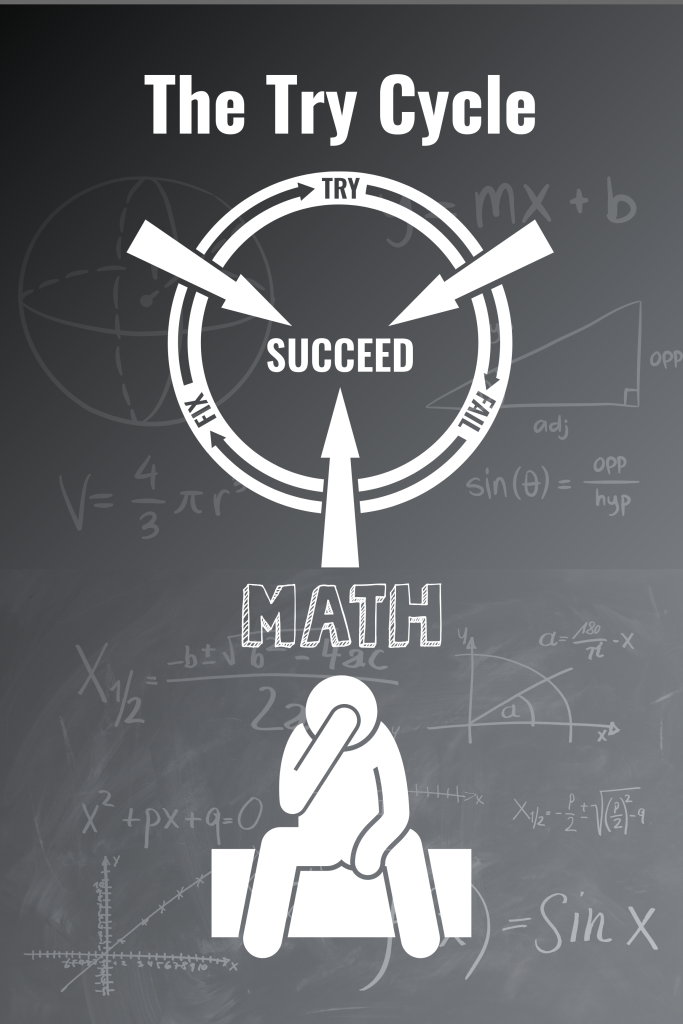
Try → Fail → Fix → Succeed
Where The Try Cycle™ Came From
The idea for The Try Cycle™ was born in an Algebra 3 classroom when I was getting frustrated with students who wouldn’t even attempt a problem unless I told them exactly what to write down
During class one day, I looked out and saw something every teacher has seen: Students sitting in silence. Papers blank. Nobody starting.
When I asked why, the answer was always the same: “I don’t get it.”
But the real issue wasn’t confusion. It was fear.
They were afraid to try because they were afraid to be wrong. So, I drew a circle on the board and wrote four words: TRY, FAIL, CORRECT, SUCCESS.
I told them that in order to learn, they must first do something wrong and then correct their mistake. During that process they would train themselves to do it correctly.
They were confused and said, “That doesn’t make sense, why would I do something wrong because then I am just teaching myself to make mistakes”
They didn’t understand that the process of making mistakes, identifying those mistakes, correcting those mistakes and doing it again was, in fact, the learning process. They were stuck on step one and never made to the end of the cycle.
We eventually changed it to Try → Fail → Fix → Succeed and named it The Try Cycle™
What The Try Cycle™ Actually Teaches
The Try Cycle™ isn’t motivational fluff.
It’s a behavioral reset. It teaches students four things most of them were never taught:
1. Try You don’t need confidence to start. You only need movement.
2. Fail Getting it wrong isn’t proof you’re bad at math. It’s proof you’re doing math.
3. Fix Mistakes show you exactly what to work on. They’re feedback, not verdicts.
4. Succeed Success isn’t a personality trait. It’s what happens after enough correct fixes.
Why This Matters (Especially in Math)
Most students don’t hate math.
They hate:
• looking stupid • being wrong in front of people • feeling behind • not knowing where to start
The Try Cycle™ gives them:
• permission to start messy • a framework for failure • a reason to keep going • a visual reminder that progress is normal
It turns “I can’t do this” into: “I just haven’t fixed this part yet.” That mindset shift is everything.